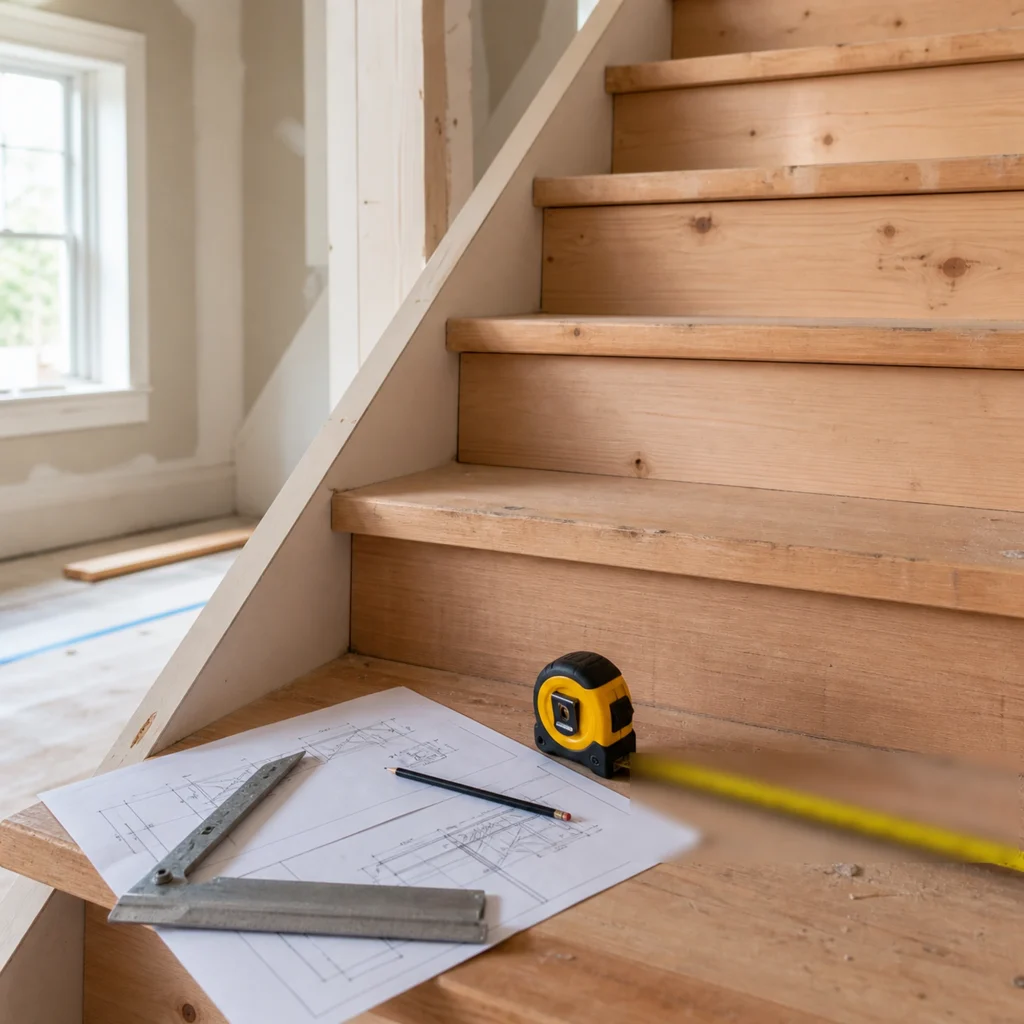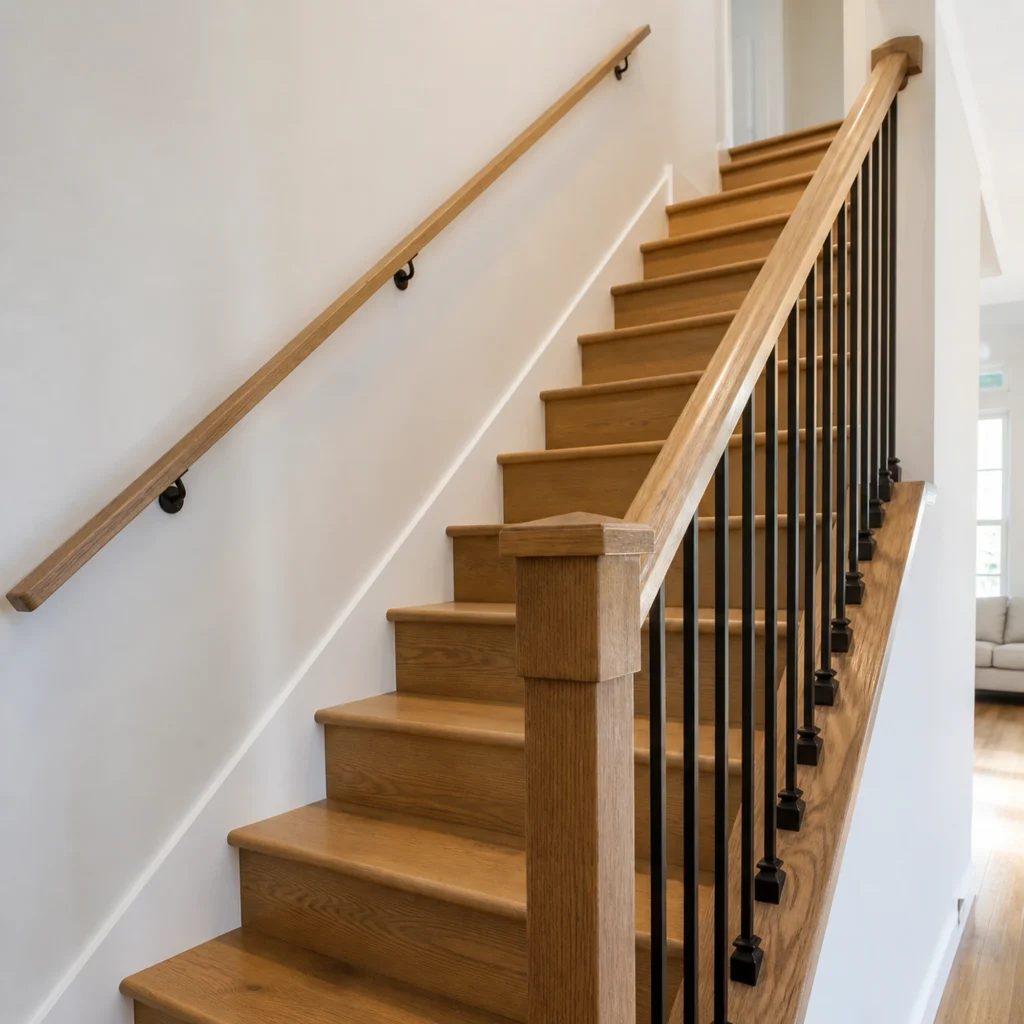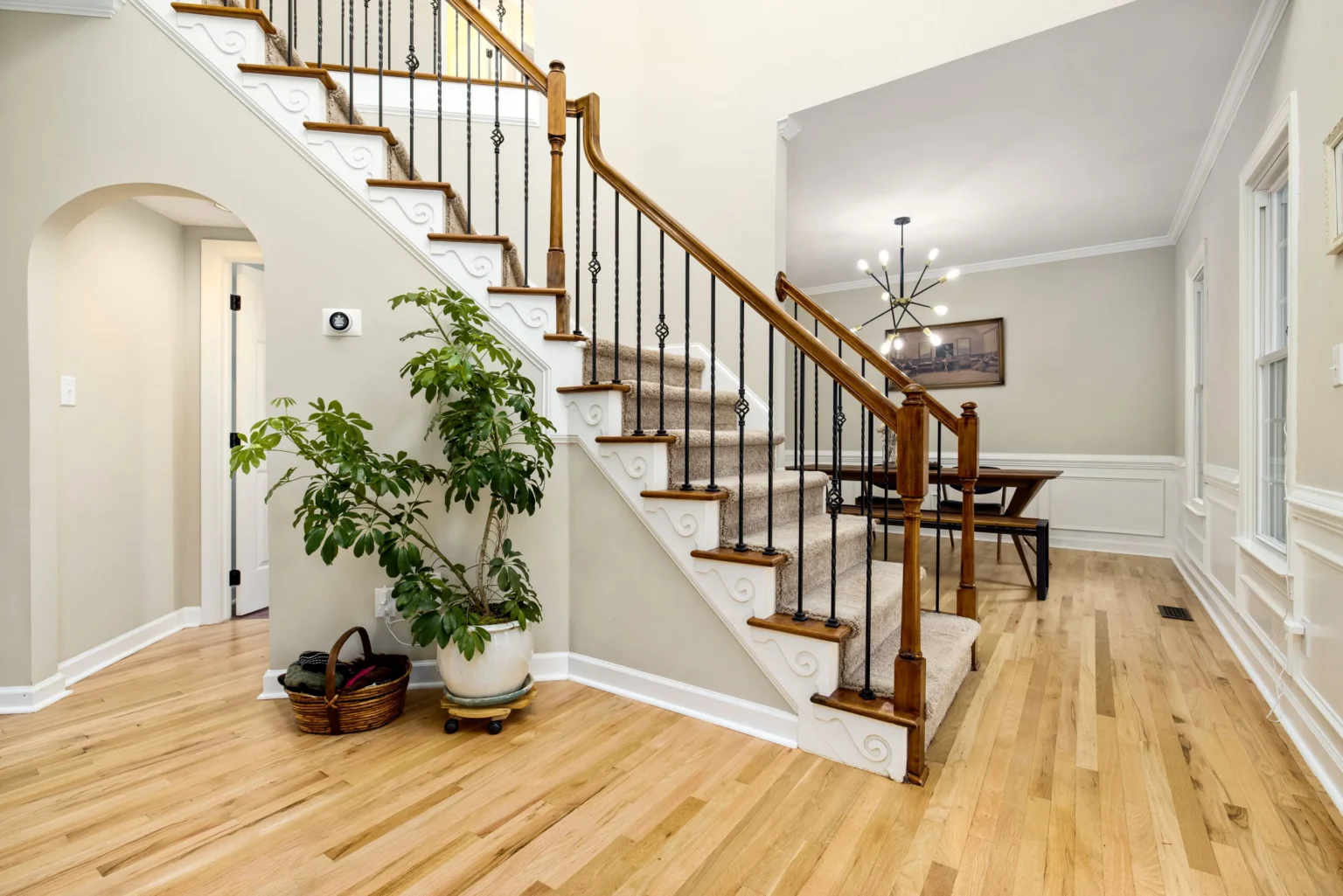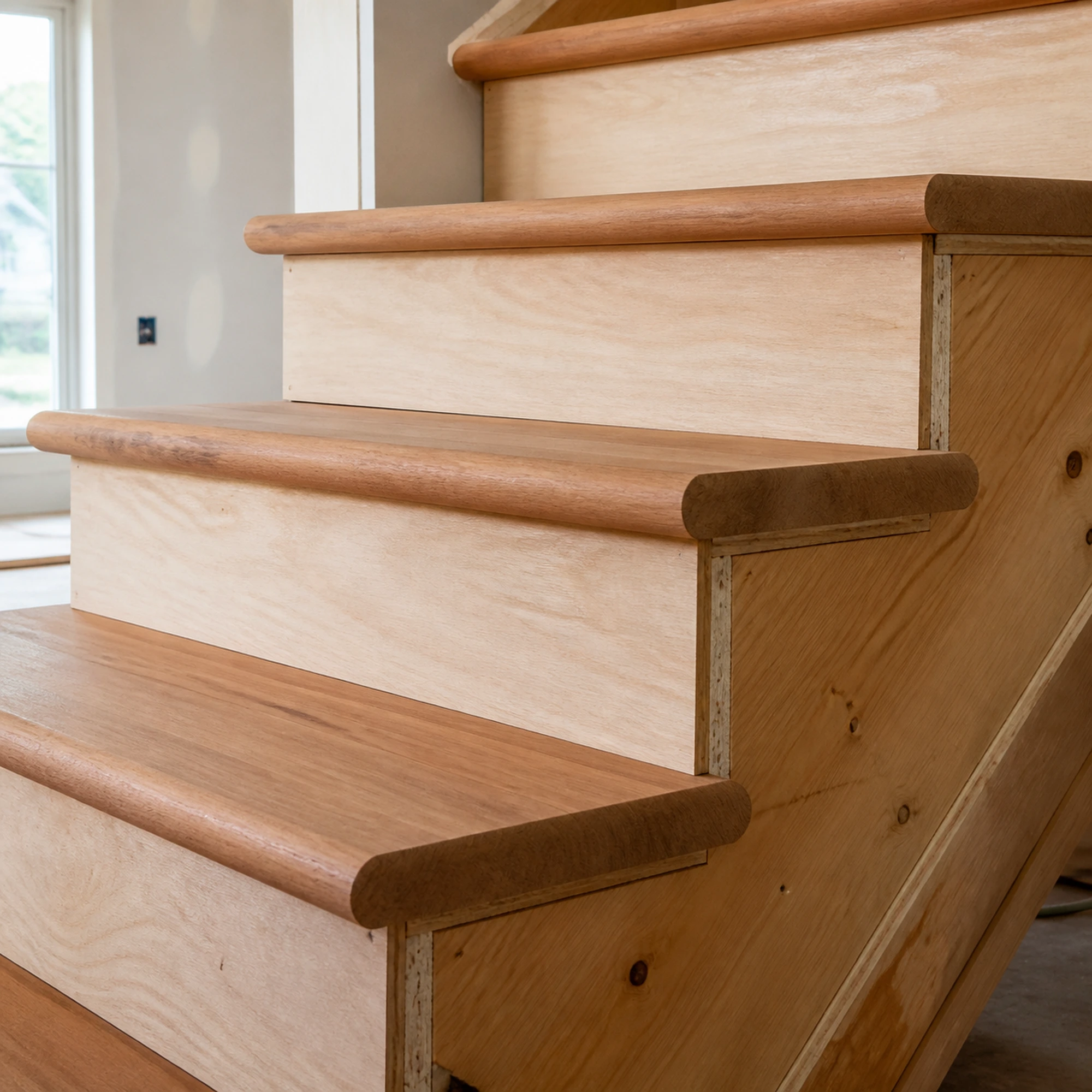
A staircase consists of three families of parts. stringer is the inclined beam that supports the whole: without it, nothing stands. The tread is the horizontal surface where the foot rests, and riser is the vertical part between two treads. stair nosing is the step portion that overflows above the riser: it improves foot support and the visibility of each level as you descend. The Code frames each of these parts — riser from 125 to 200 mm, tread depth from 255 to 355 mm, and a step whose depth does not exceed the tread depth by more than 25 mm.
Understanding this vocabulary changes the reading of an quote: it is the difference between comparing prices and comparing what you actually buy.
The lexicon at a glance
| Item | Role | Framed dimension |
|---|---|---|
| stringer | Inclined beam bearing the treads | Structural |
| Tread | Surface where the foot rests | Rotation + 25 mm maximum |
| riser | Vertical part between two treads | 125 to 200 mm |
| Giron | Useful distance between two nose | 255 to 355 mm (CCQ 2020) |
| stair nosing | Overflow above the riser | Framed by the Code |
| Flight | treads series between two levels | 3,700 mm maximum without landing |
| landing | Horizontal plane of rest | Minimum 860 mm |
| Escaped | Ground clearance above treads | Minimum 1 950 mm |
The stringer: the piece that decides everything
It is the structural element of the staircase, and its quality determines the rigidity of the whole, its lifespan and the silence of use. There are three types.
stringer rack
Cut into saw teeth, the treads resting on it. It is the most common construction in residential.It gives a visually light staircase, often open on one side.
stringer in English
The treads and risers are embedded in grooves in the stringer and then tightened with keys, which is the traditional construction, the most durable, and the one that cracks the least over time.
Central Stringer in steel
A single machined steel beam carries the treads in their middle, giving the contemporary floating staircase. Contrary to what one might think, it often returns to the treads cheaper than a classic U-shaped staircase, because there is only one load-bearing structure to be manufactured rather than two stringers profiled timber.
On the budget side, expect $200 to $1,000 for a pair of wood stringers, and $1,500 to $7,500 for a steel Central Stringer custom.
Walk and walking: two different things
This is the most common confusion. The Tread is the physical piece, in all its depth. The giron is the useful horizontal distance between the nose of one step and the nose of the next.
The Code gives a framework for this deviation: the depth of a rectangular step must not be less than its tread depth, nor exceed it by more than 1/3 of the height of the rectangular step. 25 mm.
A practical consequence for reading an quote: a supplier who advertises treads of 280 mm does not guarantee you a 280 mm girron.
The stair nosing, underestimated
It serves two purposes: it increases the foot surface without extending the staircase to the floor, and it visually materializes each level — which is important when going downstairs, where the eye is looking at the noses rather than the treads.
It is also the first part to wear out. On an old staircase, a rounded and polished stair nosing through the passage is the most reliable sign that a finishing renovation is needed. New or refurbished staircase.
Open or closed staircase
A staircase closed It looks more massive, better insulates the noise and allows to exploit the bottom in storage.
A staircase open risers: light and look through.It is suitable for open areas and dark basements.
Important point: the absence of physical riser does not exempt of the 200 mm limit between two treads.The height remains regulated even when the vertical part does not exist.
Frequently Asked Questions
What is the difference between a walk and a giron?
The step is the physical part on which the foot rests, and the ridge is the useful horizontal distance between the nose of one step and the nose of the next. The step is always a little deeper than the ridge, by a maximum of 25 mm.
What is an stringer for?
It is the inclined beam that carries the treads, it is the structure of the staircase: its quality determines the rigidity of the whole and its lifespan.
What is an stair nosing?
The portion of the step that overhangs above the riser, it increases the footrest and makes each level visible as you go down.
How much does a stringer staircase cost?
From $200 to $1,000 for a pair of stringers wood depending on the species and profile, and from $1,500 to $7,500 for a Central Stringer steel custom.
What is the difference between a fly and an landing?
The wing is a continuous series of treads between two levels, with the landing being the horizontal plane that interrupts the rise. An landing becomes mandatory as soon as the wing exceeds 3700 mm.
Is a staircase without risers compliant?
Yes, open stairs are allowed, but the height between two treads remains limited to 200 mm, and the railing remains mandatory from 600 mm of elevation difference.
Read a staircase quote
Three questions to ask consistently: what type of stringer, what exact tread depth — not the depth of walk — and what fuel for treadss.These three answers explain the majority of the price differences between two quotes.
Check out our Comparative of hardwoods, but standards of stairs, on price of a custom staircase, or Contact us.