For a staircase in Quebec, sugar maple is the hardest of the four current species, with 1450 lbf on the Janka scale, followed by white oak at 1360 lbf, red oak at 1290 lbf and birch at 1260 lbf. Black walnut, softer at about 1010 lbf, is chosen for its chocolate brown color, not for its strength. Beyond hardness, three criteria really distinguish these woods: how they take stain, their reaction to light and their stability in the face of the humidity variations of the Quebec winter.
A staircase is not a floor, it concentrates the passage on a narrow strip, is subject to impacts on the stair nosing and is less easy to clean. The choice of wood species therefore weighs heavier than on a floor surface.
Comparative table
| Wood Species | Janka Hardness | Natural color | Stain Response |
|---|---|---|---|
| Sugar Maple | 1 450 lbf | Very pale cream white, fine grain | Difficult — tends to marble |
| oak white | 1 360 lbf | Beige to golden brown | Excellent |
| oak red | 1 290 lbf | Reddish brown, open grain | Excellent |
| birch (yellow birch) | 1 260 lbf | Cream white to golden brown amber | Good, nuanced |
| Black walnut wood | ≈ 1 010 lbf | Deep chocolate brown | Rarely dyed — natural color |
How to read the Janka scale
The test measures the force required to push a 11.3 mm (0.444 in) steel ball to half its diameter into a sample dried at 12% moisture, and the result is expressed in pounds of force.
A high figure is not always an advantage. The red oak at 1,290 lbf serves as the middle ground in the industry precisely because it offers the best compromise: hard enough to withstand passage, workable enough to be sawed, nailed and profiled without difficulty.Exotic species like ipé rise to nearly 3,700 lbf, but become tedious to machine and do not lend themselves well to the manufacture of a custom staircase.
The useful window for a residential staircase is located between 1,200 and 1,500 lbf. The five above essences are there or approach it.
The four essences in detail
Sugar Maple — the most resistant
It is the hardest species of common Quebec hardwoods, with a tight and very uniform grain and an almost white hue. It is particularly suitable for contemporary interiors and high-traffic staircases.
Its limit: The closed grain of stain absorbs the product unevenly, which produces a marbled effect if the application is not controlled. A dark maple stained requires a primer and an expert hand.It also visibly pales under strong exposure to the sun.
oak white — the most versatile
Almost as hard as maple, but with an open grain that accepts remarkably well stain, it is the essence to be preferred for a staircase stained custom, from blond to very dark brown.
These are: oak white prefers milder climates than oak red and grows less abundantly in Quebec, and is generally more expensive to procure.
oak red — the reference
The best balance between hardness, availability and ease of work.The open and irregular grain is a practical advantage: it naturally masks the marks of wear. A scratch on a stair nosing in red oak is much less noticeable than on a maple.
Its warm reddish brown hue is suitable for both classic and contemporary interiors, and it accepts all stains.
birch — the Quebec essence
birch, or yellow birch, is the iconic tree of Quebec. Its straight and closed grain gives a uniform appearance, sometimes wavy or pearlescent depending on the lighting.
Its advantage over the maple: it changes less in hue under the effect of light, which avoids demarcation if one part of the staircase is more exposed than another.
Black walnut — for color
The softest of the five, and the darkest, it is chosen for its natural chocolate brown, which no stain really replicates. On a staircase, it scores more easily — a compromise taken for the sake of character.
Three criteria more decisive than hardness
The plug of stain
If you want a dark stained staircase, go for oak, if you like light, natural wood, maple and birch will give excellent results without stain.
The reaction to light
All woods evolve, but not at the same rate: maple pales, birch darkens slightly, walnut lightens over time. In a stairwell with a large window, this evolution can create a visible difference between the top and bottom after a few years.
Stability to moisture
The Quebec winter dries the indoor air; the summer loads it with moisture. Wood works. A staircase made with insufficiently dried wood will eventually crack or present play to the assemblies. That is why we condition our wood in the workshop before machining, rather than working them on reception.
Which fuel for which situation?
- High traffic staircase, family with children or pets → oak red. Its hardness is sufficient and its grain masks the wear.
- Staircase stained dark → oak white or oak red. The stain will be uniform.
- Contemporary interior, light wood → Sugar Maple, left natural or clear varnished.
- Looking for a warm character without stain → birch.
- Centerpiece, comfortable budget → black walnut, accepting that it scores more.
Frequently Asked Questions
What is the hardest hardwood for a staircase?
The sugar maple, with 1450 lbf on the Janka scale, followed by the white oak (1360 lbf), the red oak (1290 lbf) and the birch (1260 lbf).
What is the Janka scale?
A test that measures the force needed to push a 11.3 mm steel ball at half-diameter into wood, expressed in pounds of force, the threshold of the hardwood is around 950 lbf.
Should I always choose the hardest wood?
No, above 1,500 lbf, wood becomes difficult to machine without any real gain in durability in residential use. The useful window for a staircase is between 1,200 and 1,500 lbf.
Which wood to choose for a stained dark staircase?
A oak, white or red, with an open grain that absorbs stain evenly. The maple, with a closed grain, tends to marble.
Are birch and yellow birch the same species?
Yes, in Quebec, birch is used to refer to yellow birch, not to be confused with white birch or cherry.
Which petrol marks the least?
Its hardness is correct, but above all its open and irregular grain naturally masks scratches, unlike the maple whose uniform surface reveals every mark.
Choose in showroom
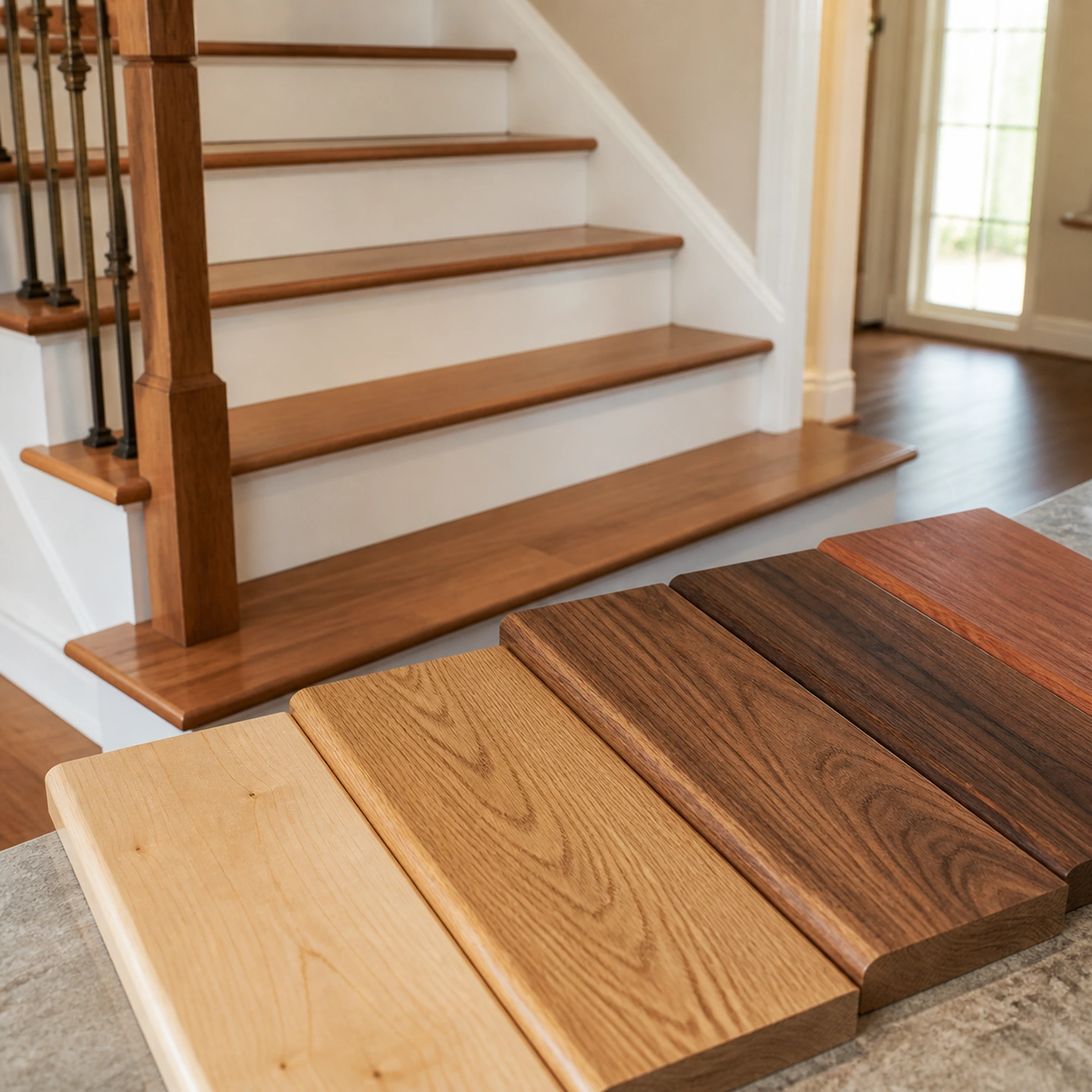
A photo never gives the true color of a wood: lighting, finish and essence interact.We keep samples of each essence, with different stains and finishes, in our Granby workshop.
See also the price of a custom staircase, our manufacturing steps, browse Our Staircases or Contact us.