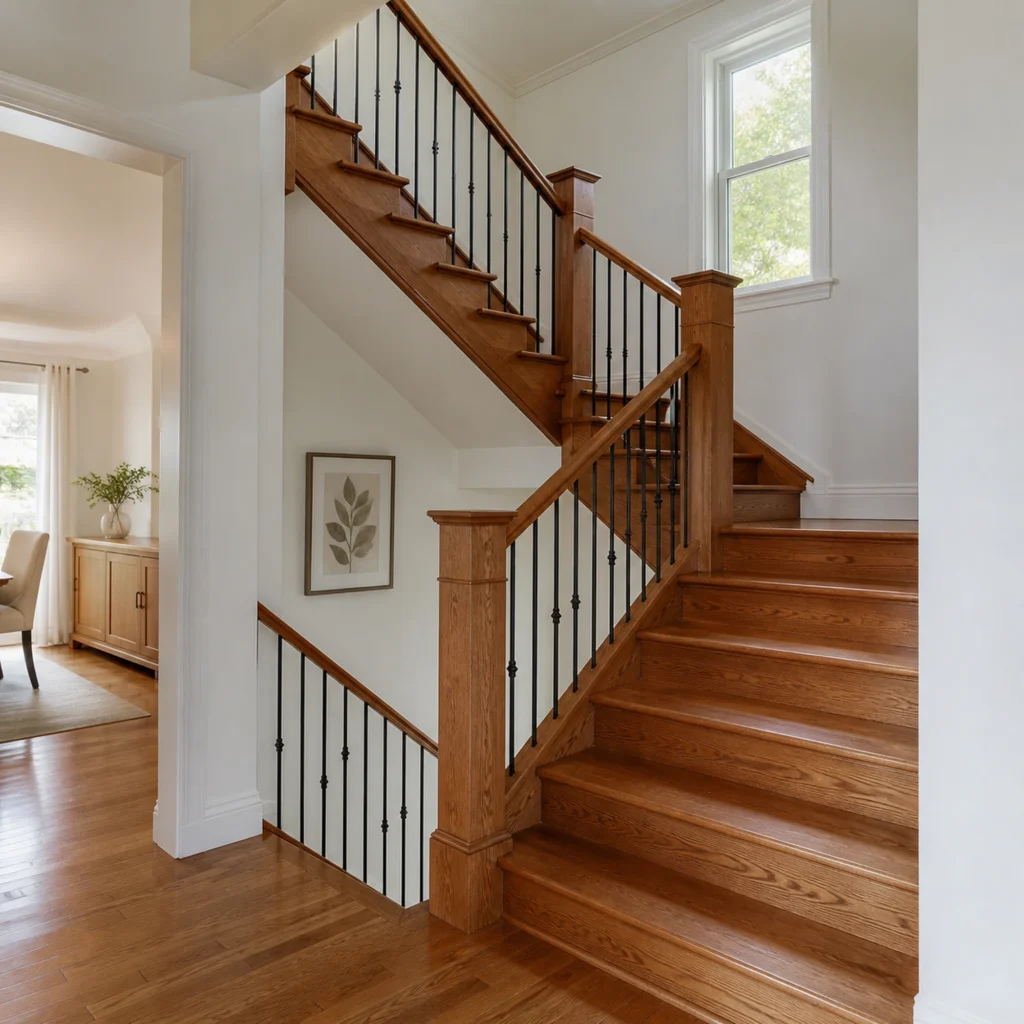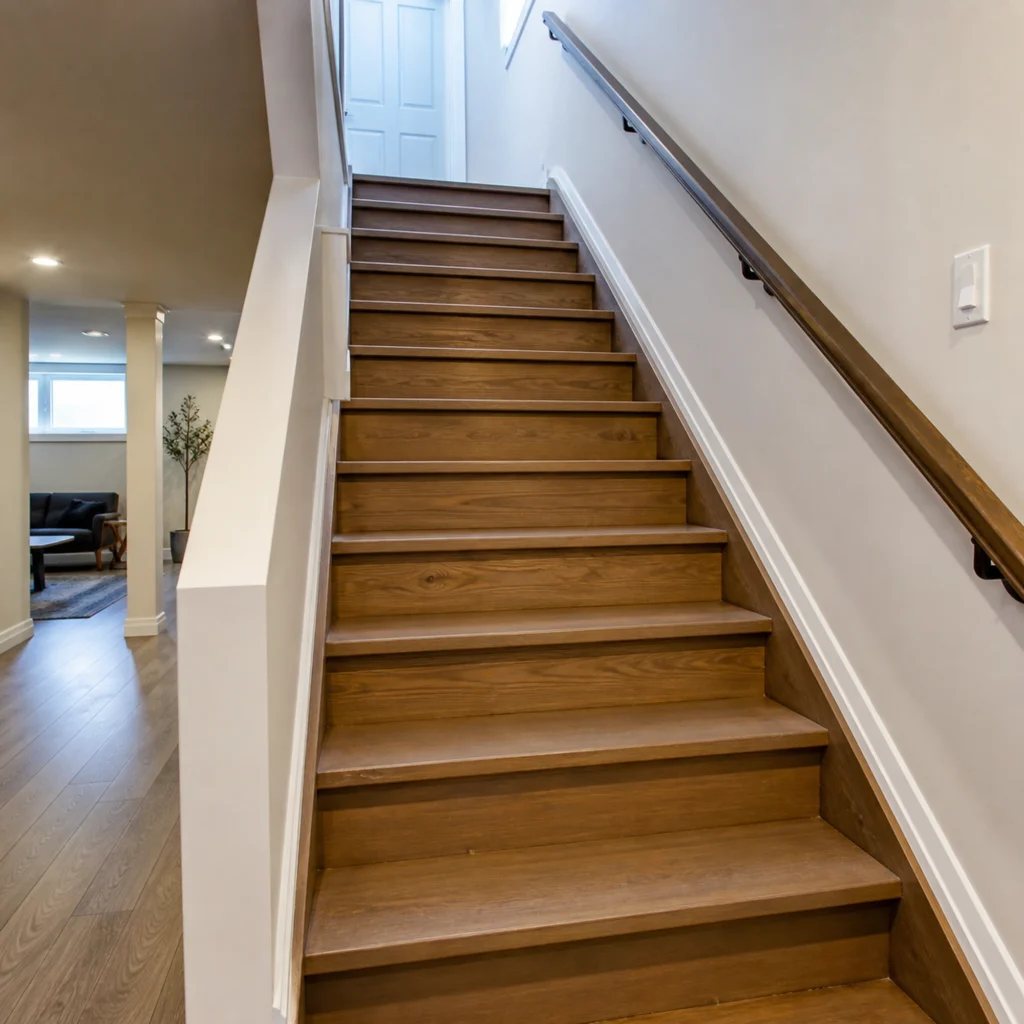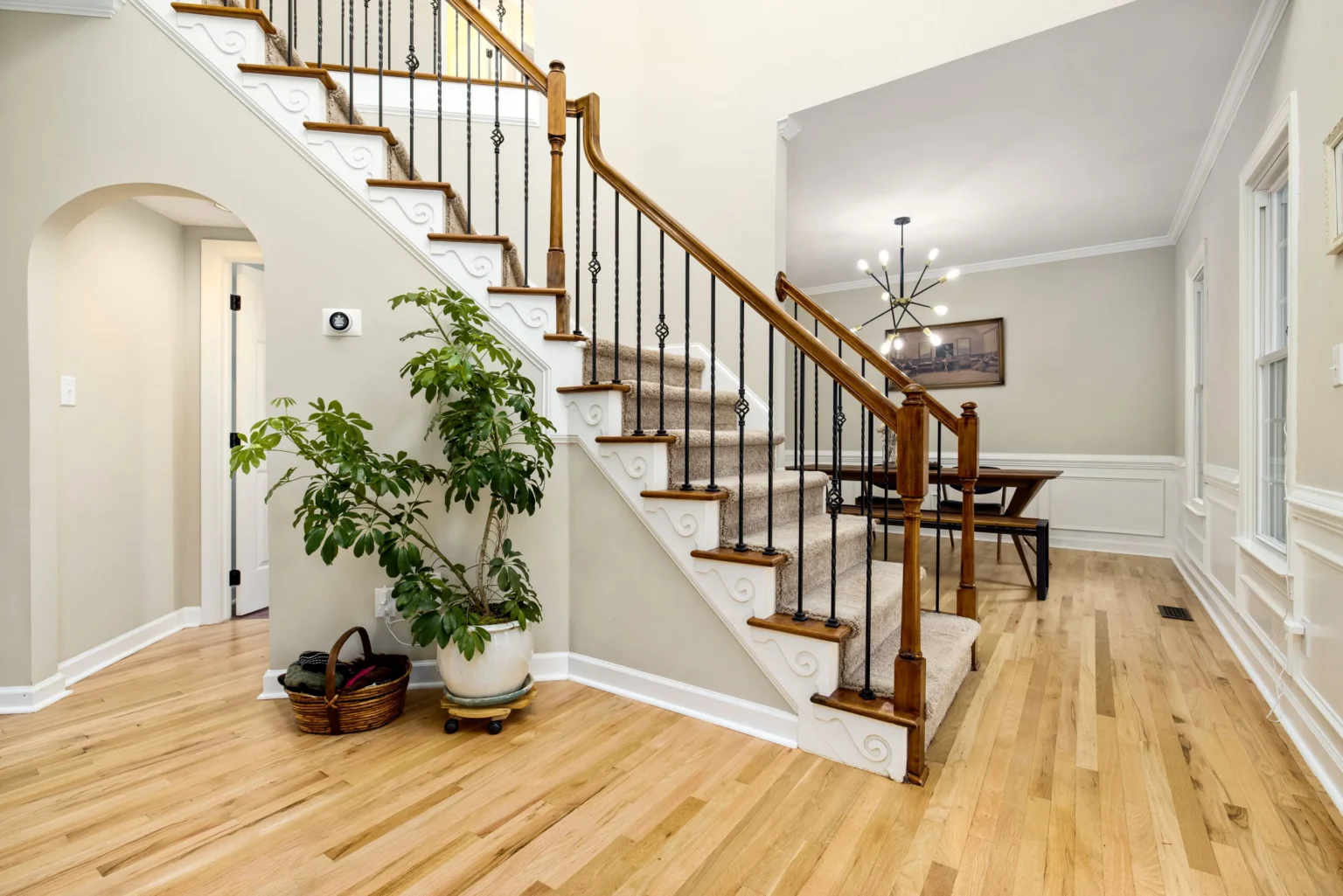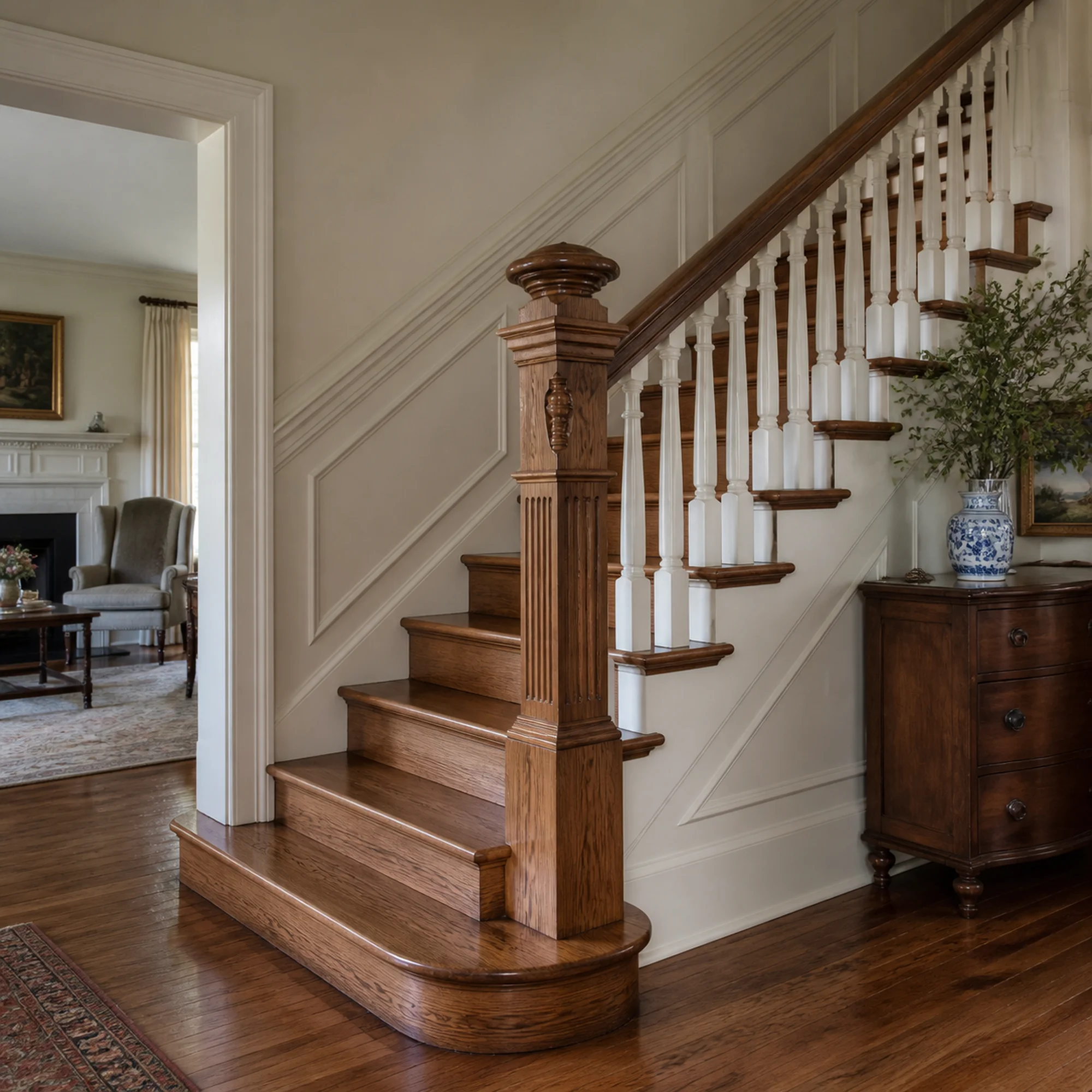
A classic staircase is recognizable by four elements: solid risers, moulded stringers, lathe-turned balusters, and a decorative newel post that visually anchors the whole. It is usually made in red oak or warm birch, stained, with a rounded stair nosing. Expect $4,000 to $10,000 installed for a straight flight with full railing — the difference with a contemporary model comes mainly from the number of turned and moulded parts.
It is the most common style in Quebec’s housing stock, and the one that ages best: it does not depend on any trends.
The four markers of style
Closed Risers
The classic staircase is closed. Each step rests on a vertical riser, which gives a continuous and massive silhouette.This also allows the bottom to be used as storage or a cupboard.
Profiled Stringer
Where a contemporary staircase shows a clear beam, the classic dresses its stringer with a moulding that follows the line of the staircase, an expensive detail in workshop hours, and immediately identifiable.
Turned Balusters
Each baluster is turned, with bulges and grooves, and a staircase of fourteen treads has about thirty of them — hence the price difference with balusters steel straight.
The Newel Post
The centerpiece. More massive than the balusters, often sculpted or molded, it marks the beginning of the flight and absorbs the efforts of the handrail.It is it that gives its character to the whole.
What has changed, and what hasn’t changed
| Component | In the past | Today |
|---|---|---|
| Assemblage | stringer English, wooden keys | Idem, with modern collage |
| Finition | Varnish applied on site | Prevented in the workshop, more regular |
| balusters | Turned by hand | Turned, often on digital template |
| Height of railing | Variable, often below 900 mm | Minimum 900 mm required |
| Spacing of the balusters | Often greater than 100 mm | Maximum 100 mm |
| Giron | Frequently below 255 mm | 255 mm minimum (CCQ 2020) |
This is the point that many owners discover late: an original classic staircase is very often non-compliant todayIn homes built before 1980, too short arms, too high riserss and too wide balusterss are the rule rather than the exception.
This is not a problem as long as the staircase remains in place. It is one that arises during a sale, a pre-purchase inspection or a claim. staircase standards in Quebec.
Reproduce an old staircase in the identical
This is a frequent request in heritage renovation, and it has a limit: non-conforming dimensions cannot be reproducedThe style may be followed in detail—profiles of mouldings, design of balusters, shape of the post—but the tread depth, riser height and spacing of balusters must follow the current Code.
In practice, the reconstructed staircase often has one step more than the original, since the risers becomes lower.
Modernize without denaturation
Three interventions give a contemporary result while preserving the classical structure:
- Replace the balusters turned by steel straight balusters, keeping the handrail and the wooden pole, which is the most spectacular intervention for the budget.
- Lighten the stain. A dark walnut classic staircase stained immediately appears lighter in blond or natural.
- Paint the risers and stringers in white, leaving the treads in wood, a contrast very common in Quebec, which lightens the silhouette without touching the structure.
Frequently Asked Questions
What characterizes an classic staircase?
Solid risers, a stringer profiled with mouldings, balusters turned on the lathe and a decorative newel post.Generally in oak red or birch, stained in warm tones.
Is an old classic staircase compliant today?
In houses built before 1980, the gaps are often less than 255 mm, risers are more than 200 mm and balusters are more than 100 mm apart.
Can an old staircase be reproduced exactly?
The profiles, mouldings and shapes are faithfully reproduced, but the tread depth, riser height and the spacing of balusters must comply with the current Code.
How much does an classic staircase cost?
From $4,000 to $10,000 installed for a straight flight with full railing.The turned balusters and the profiled stringers explain the difference with a contemporary model.
How to upgrade an classic staircase without replacing it?
Replace the turned balusters with steel balusters straight, lighten the stain, or paint risers and stringers white while keeping the wooden treads.
What petrol for an classic staircase?
The red oak and birch are the most common, the oak accepts traditional dark stains particularly well, and its open grain masks wear.
See the two styles side by side
The difference between a classic staircase and a contemporary model is not easily judged on a photo: it is a matter of proportions and profiles.Our achievements cover both registers.
Browse No. classic staircases, our achievements, on Comparative analysis of species, or Contact us.