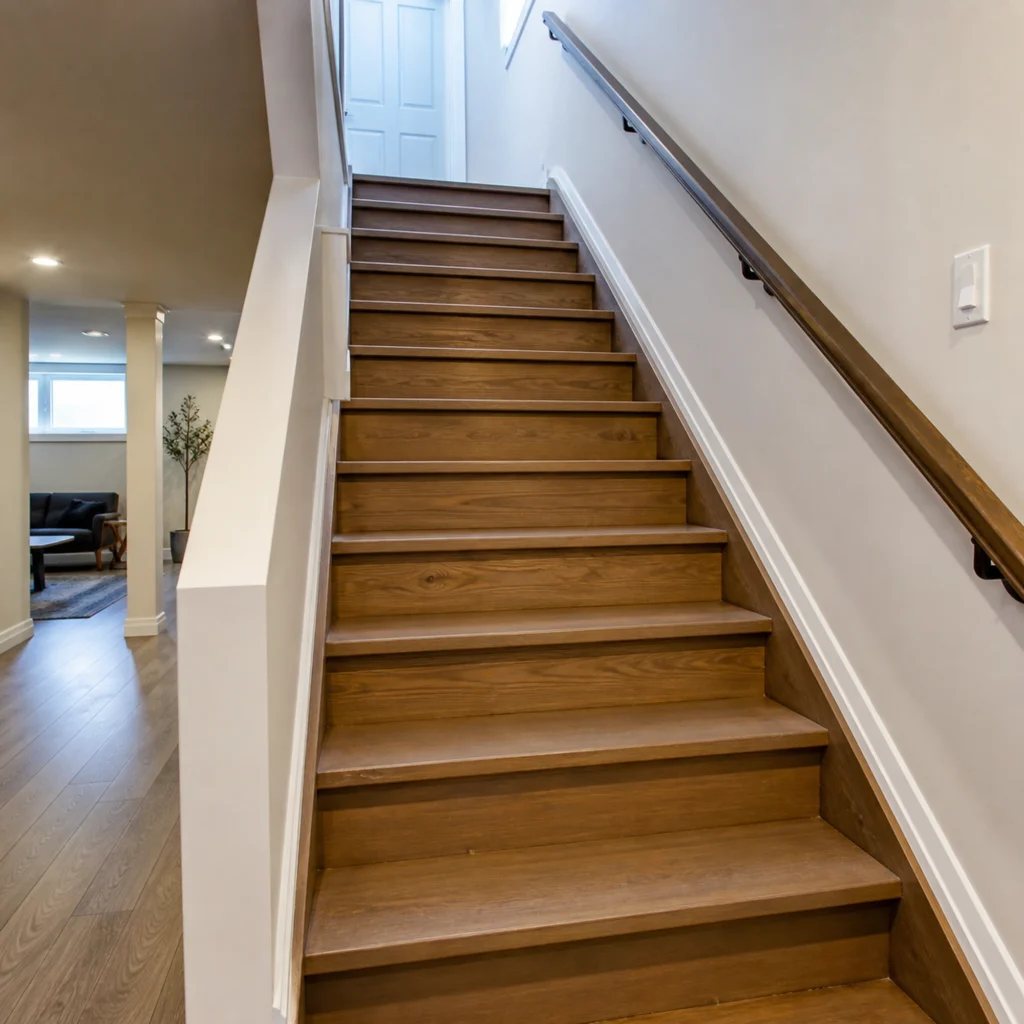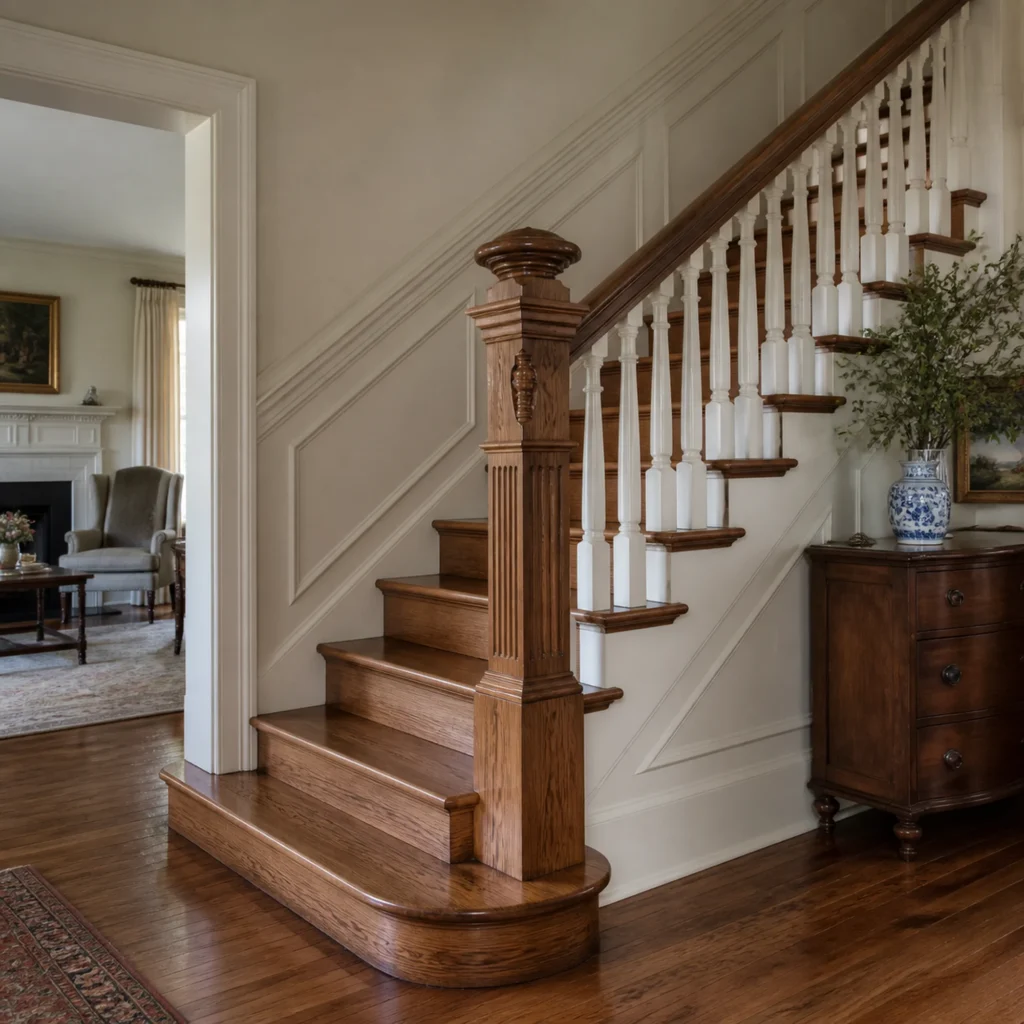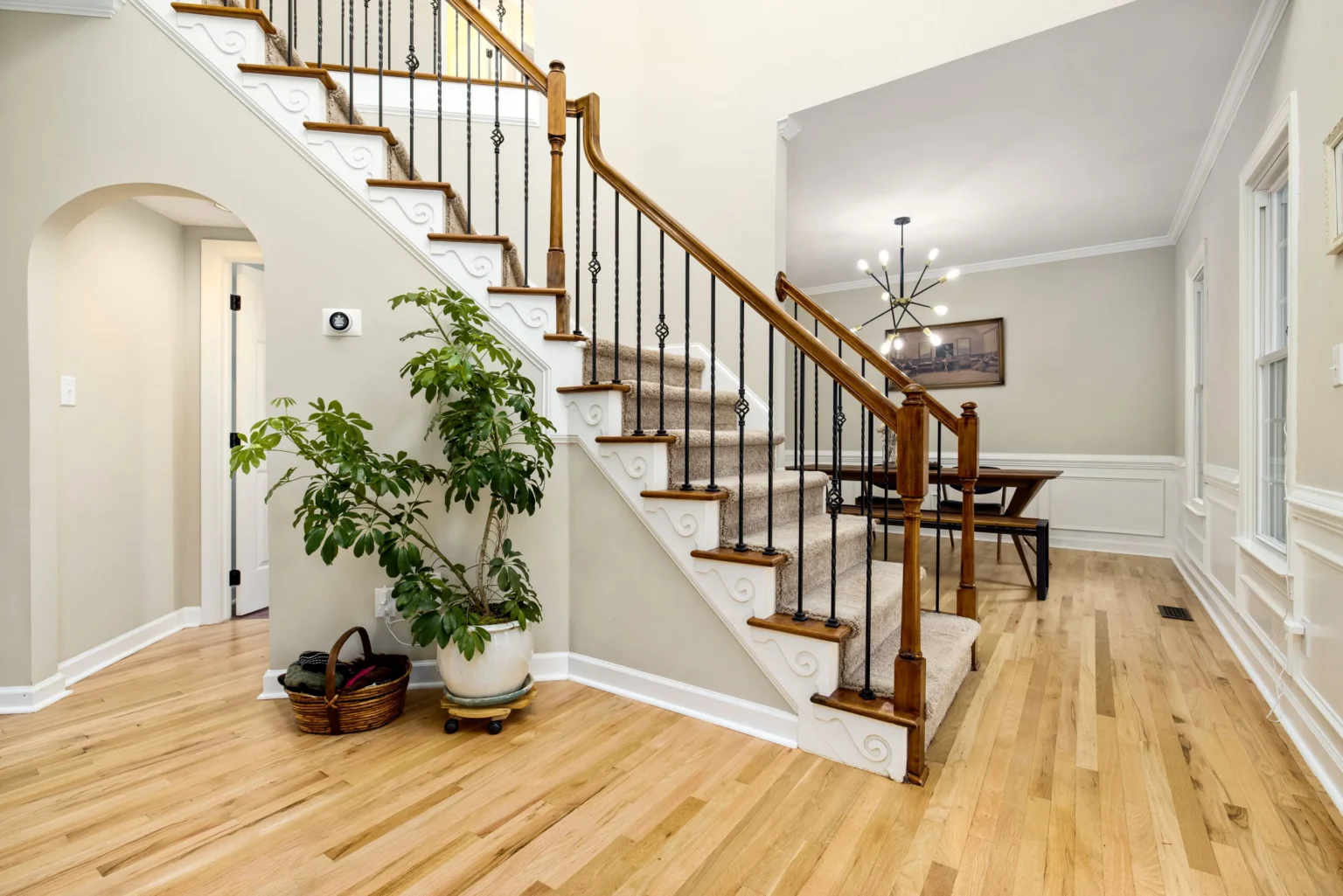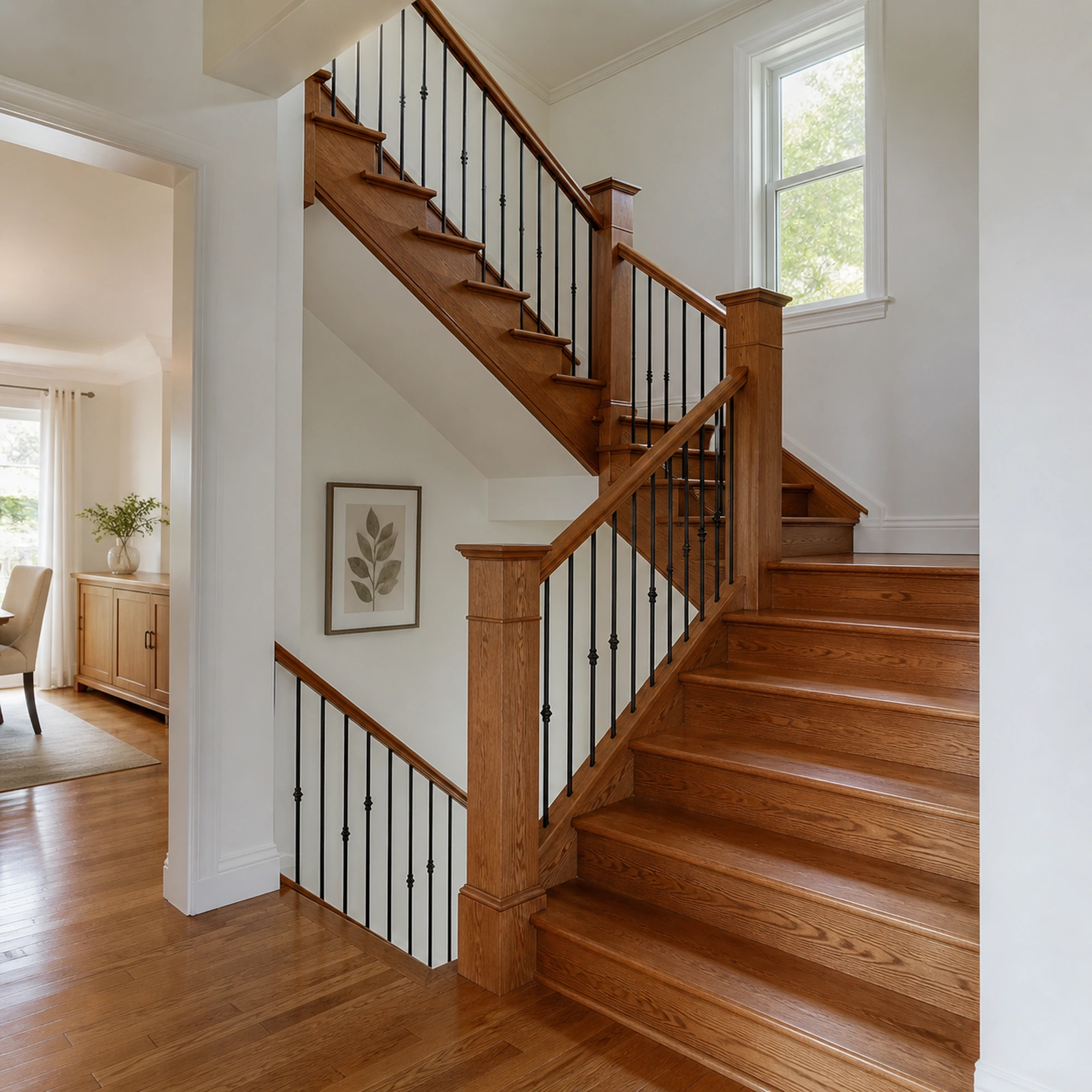
A winder staircase changes direction by winder treads, narrower on the inside, around an angle: it is the quarter turn (in L) or half turn (in U). A spiral staircase describes a continuous curve around a central axis, without landing or angle. On the practical side: the turn takes less ground length than a straight staircase while remaining comfortable; the spiral staircase has the smallest footprint but quickly becomes impractical for everyday use or for mounting furniture. Expect $ 4,500 to $ 12,000 for a turn, $ 8,000 to $ 20,000 for a spiral staircase.
The choice is rarely based on aesthetics alone, it depends on the available space, the frequency of use and what will have to pass through the staircase.
Comparative table
| Winder Staircase | spiral staircase | |
|---|---|---|
| Geometry | Angle 90° or 180° | Continuous curve around an axis |
| footprint | Average | Low |
| Daily comfort and comfort | Good | Limited |
| Transition of furniture | Correct | Difficult |
| landing possible | Yes | No |
| Complexity of manufacturing | High | Very high |
| Installed range | 4 500 $ – 12 000 $ | 8 000 $ – 20 000 $ |
Why these stairs cost more
A straight staircase is produced in series: all treads have the same geometry, and as soon as it turns, each corner step becomes a unique piece, to be traced, cut and adjusted individually.
That’s why a winder staircase costs 60 to 100% more that an equivalent right, and why the railing that accompanies it adds another 30 to 50%, each section having to marry the curve.
The technical key: the footprint
On a straight staircase, the tread depth is simply measured from one stair nosing to the next, on a winder staircase or spiral, the treads are narrower on the inside and wider on the outside.
The Code therefore requires that the tread depth be measured on the line of footing — the natural path of the foot, located at two-thirds of the width from the inner side, where the minimum of 255 mm must be respected.
Practical consequence: a compliant spiral staircase requires a sufficient diameter. Compact models sold as kits rarely achieve compliance for a main housing staircase. calculator gives you the reference dimensions to respect.
The three rotating configurations
Quarter turn (in L)
This is the most common configuration in Quebec: it shortens the footprint while remaining comfortable, and fits well into a corner staircase.
Half turn (in U)
It occupies a compact grip and allows the insertion of a intermediate landing — mandatory as soon as the flight exceeds 3,700 mm.
Double quarter turn
Two 90° turns separated by a straight flight, useful to circumvent a structural obstacle or to adapt to a particular part geometry.
When spiral is the right choice
It is in three specific cases:
- The floor space is really insufficient for any other configuration.
- The staircase is secondary — access to a mezzanine, an office, a fitted attic — not the main staircase of the dwelling.
- The architectural effect is sought and assumed as the centerpiece of the room.
It is much less as a main staircase of a family home: climbing a mattress or a household appliance by a spiral is an accomplishment, and the descent requires constant attention.
What does not change
Regardless of the shape, the requirements remain the same: riser from 125 to 200 mm, minimum width of 860 mm, escape of 1950 mm, railing from 600 mm of difference in height and maximum spacing of 100 mm between balusters. staircase standards in Quebec.
Frequently Asked Questions
What is the difference between an spiral staircase and a spiral staircase?
In common usage, both terms mean the same thing: a staircase that describes a continuous curve around a central axis, without landing or angle.
Is a winder staircase more expensive than a straight staircase?
Yes, 60 to 100% more.Each corner step is a unique piece that must be plotted, cut and assembled individually.
How do you measure the tread depth on a winder staircase?
On the footline, located at two-thirds of the width from the inside, where the minimum tread depth must be observed.
Can an spiral staircase be the main staircase of a house?
This is possible if the diameter allows to respect the tread depth on the line of footing, but not recommended: the passage of furniture is very difficult and the daily comfort remains limited.
Which staircase takes up the least space?
The spiral, followed by the U-shaped half-turn. The straight staircase occupies the largest length on the ground.
Do I need an landing on a winder staircase?
A landing becomes mandatory as soon as the height of a window exceeds 3,700 mm.The half-turn allows one to be inserted naturally at the change of direction.
See before you choose
The difference in comfort between a quarter-turn and a spiral is felt when climbing, not on a plane.Our projects cover both configurations, and we evaluate on site what your space really allows.
Browse Our Staircases, page spiral staircase, our achievements, or Contact us.