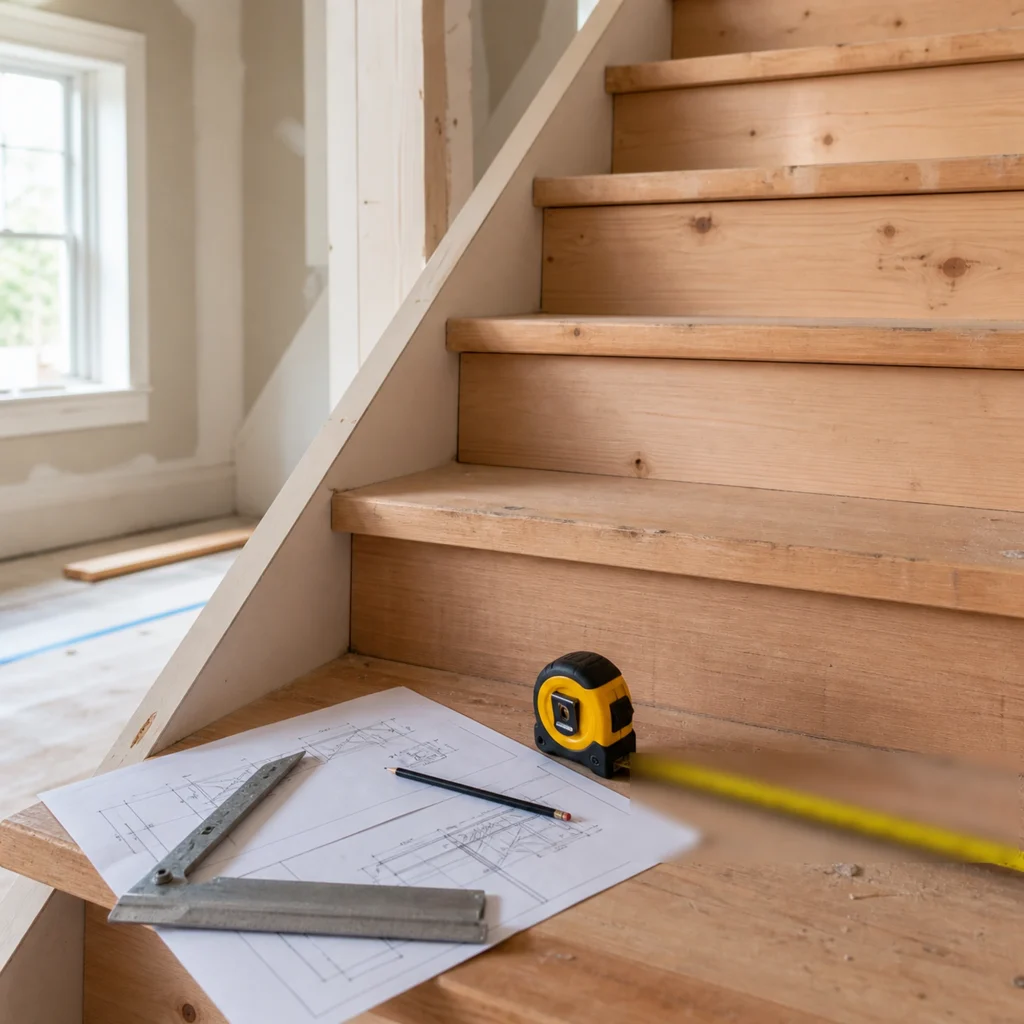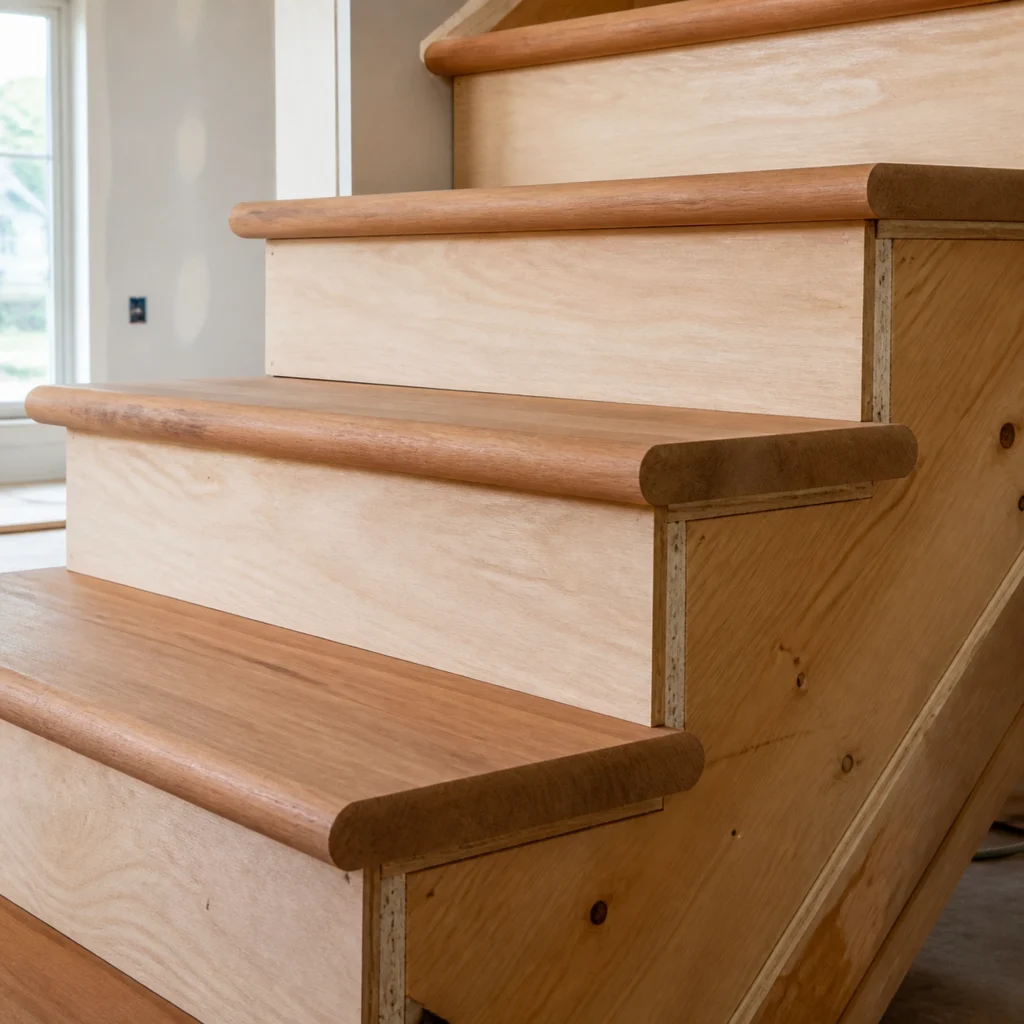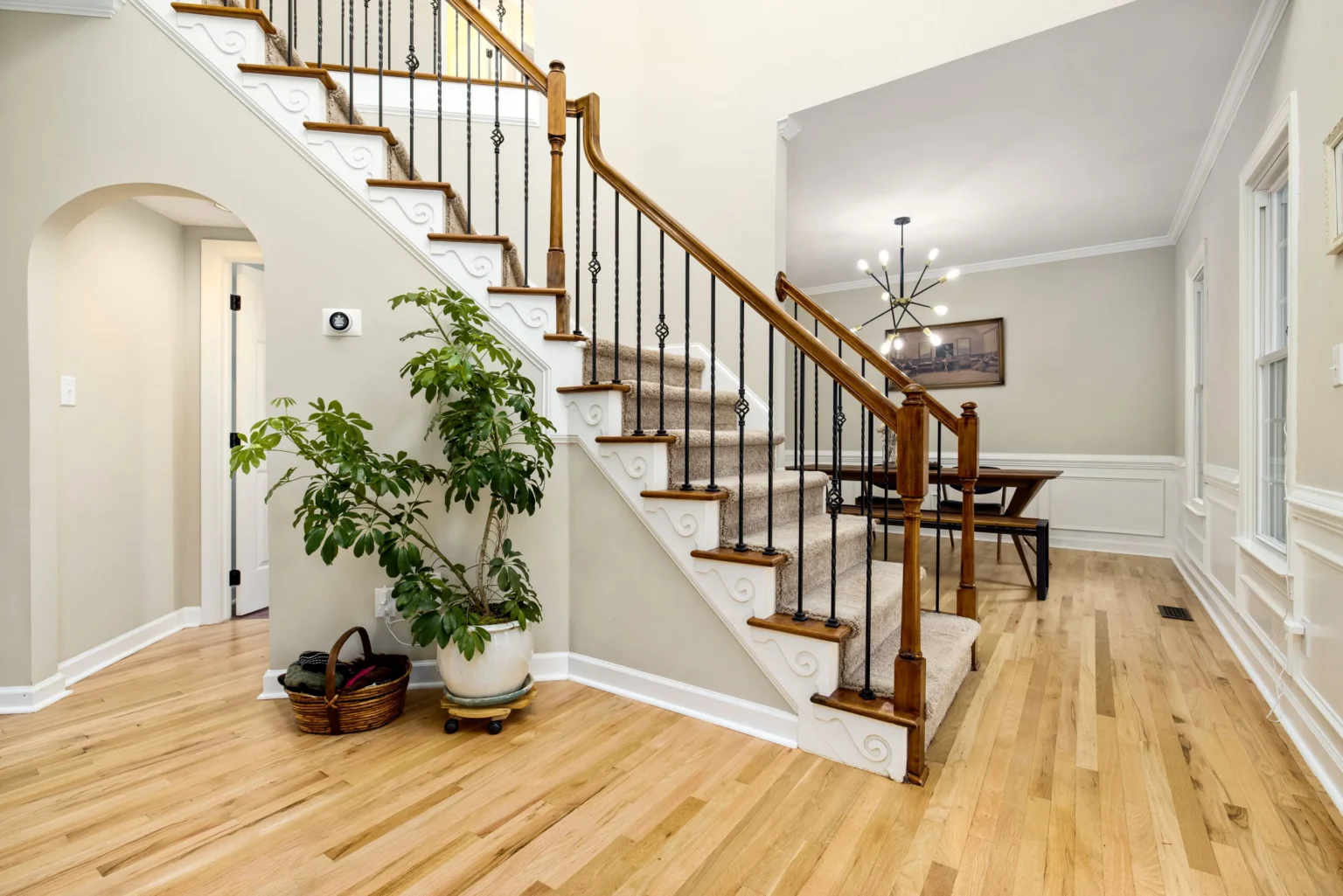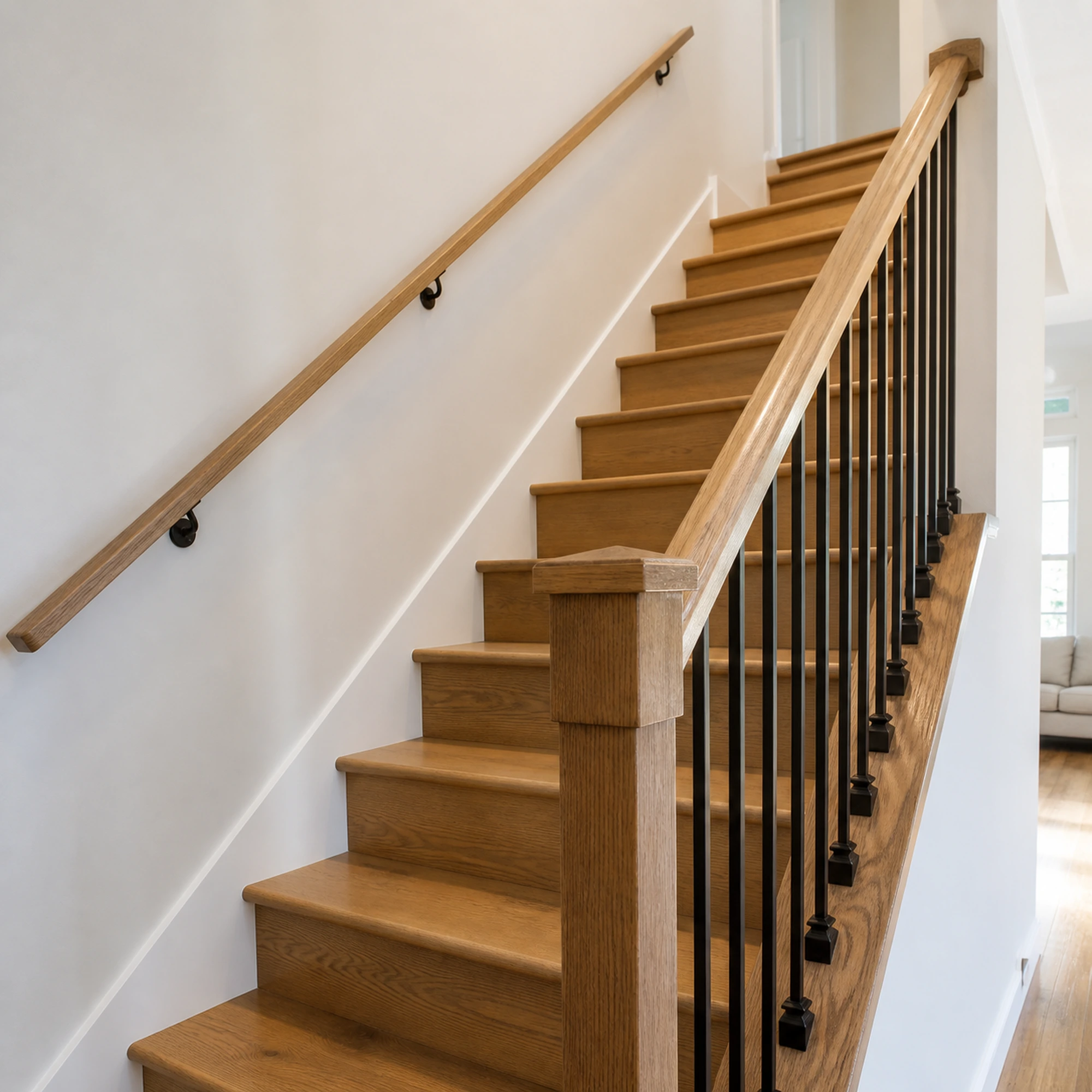
These three words are distinct elements. railing is the vertical barrier that prevents the fall: mandatory from 600 mm of elevation difference, minimum height of 900 mm along a flight and 1070 mm at a landing. handrail is the continuous element that the hand grabs to support itself: mandatory from the third riser, at a height of 865 to 965 mm measured from the stair nosing. The word “railing” is not a Code term — in Quebec usage, it commonly refers to the combination of railing and handrail.
This confusion is common, even among contractors, and has a concrete consequence: a handrail installed at the height of a railing is not compliant, and too high to be comfortably grasped.
Table of the three elements
| railing | handrail | |
|---|---|---|
| Function | Prevent the fall | Support the hand |
| Trigger | Over 600 mm elevation difference | More than 2 risers |
| Height in flight | Minimum 900 mm (36 in) | 865 to 965 mm (34 to 38 in) |
| Height at landing | Minimum 1070 mm (42 in) | 865 to 965 mm |
| Measuring point | Since the stair nosing | Since the stair nosing |
| Openings | Maximum 100 mm between balusters | Not applicable |
| Prehension | Not applicable | Approximately 30 to 50 mm in diameter |
The most common mistake
We regularly see handrails placed at 1070 mm (4.3 inches) because this figure is circulated as the “standard for railings”.
The 1,070 mm is for the railing of an landing or a mezzanine, where the risk of falling is greater and the barrier is higher. Along a flight, the handrail must remain between 865 and 965 mm. Otherwise, the hand will no longer naturally land on it as it descends, thus nullifying its purpose.
The 100 mm rule
No 100 mm spheres should pass through the railing, and the rule is in place to prevent a young child’s head from passing between two balusters.
It applies to all openings, including the one between the stringer and the first baluster, often overlooked, an inspector checks it on the template, without tolerance: an opening of 105 mm is rejected.
The continuity of the handrail
Two requirements that are not known, but that are verified in inspection:
- handrail should remain continuous over the entire length of the staircase, landings included.
- It shall not not change side A visually impaired or elderly person must be able to follow the landing without having to look for it.
A staircase 1100 mm wide or larger requires a handrail on each side.
Prices according to material
The railing is priced per linear foot and often accounts for 15-30% of a staircase budget — the most underestimated item.
| Type | Price per linear foot | 12 ft. straight wing |
|---|---|---|
| handrail wall mounted alone | 10 $ – 50 $ | 120 $ – 600 $ |
| Classic wood, balusters turned | 80 $ – 200 $ | 960 $ – 2 400 $ |
| Wood and steel balusters | 120 $ – 250 $ | 1 440 $ – 3 000 $ |
| Stainless Steel Wire Rope | 130 $ – 300 $ | 1 560 $ – 3 600 $ |
| Tempered glass, steel poles | 150 $ – 400 $ | 1 800 $ – 4 800 $ |
| wrought iron working | 200 $ – 400 $ | 2 400 $ – 4 800 $ |
| Glass without frame | 300 $ – 600 $ | 3 600 $ – 7 200 $ |
Two factors increase the bill beyond the material: the form (each change of direction multiplies the cuts and connections) and the hardware, including invisible glass fasteners.
The glass railing and the standard
The glass railing is subject to the same requirements: minimum height and no openings greater than 100 mm. The glass must be tempered, and the whole must withstand a side push. Ask for engineering reports valid for Quebec — a reliable supplier will provide them without hesitation.
Frequently Asked Questions
What is the difference between a railing and a handrail?
“railing” is a commonly used term for the railing and handrail as a whole, and the handrail is precisely the continuous element that is grasped with the hand to support itself.
How high to install a handrail?
Between 865 and 965 mm (34 to 38 in), measured vertically from the stair nosing, not to be confused with the 1070 mm, which applies to the railing of an landing.
What is the height of an interior staircase railing?
Minimum 900 mm (36 in) along the fly in a housing, and 1070 mm (42 in) at landing or mezzanine.
From how many treads is the handrail mandatory?
As soon as a staircase has more than two risers, that is, from the third step.
When do you need a handrail on both sides?
As soon as the staircase reaches 1100 mm in width.
What is the maximum spacing between the balusters?
100 mm (4 in.) No spheres of this diameter must pass through, including between the stringer and the first baluster.
How much does an stair railing cost in Quebec?
From $80 to $200 for a wooden linear base, from $150 to $400 for tempered glass and up to $600 for glass without a frame.
Choose informed
We manufacture and install the railing in wood, steel, wrought iron and glass, with the matching handrail.Each set is measured on site, which avoids unpleasant surprises at inspection.
Visit our pages railing, handrail, stair railing indoor, but standards of stairs, or Contact us.