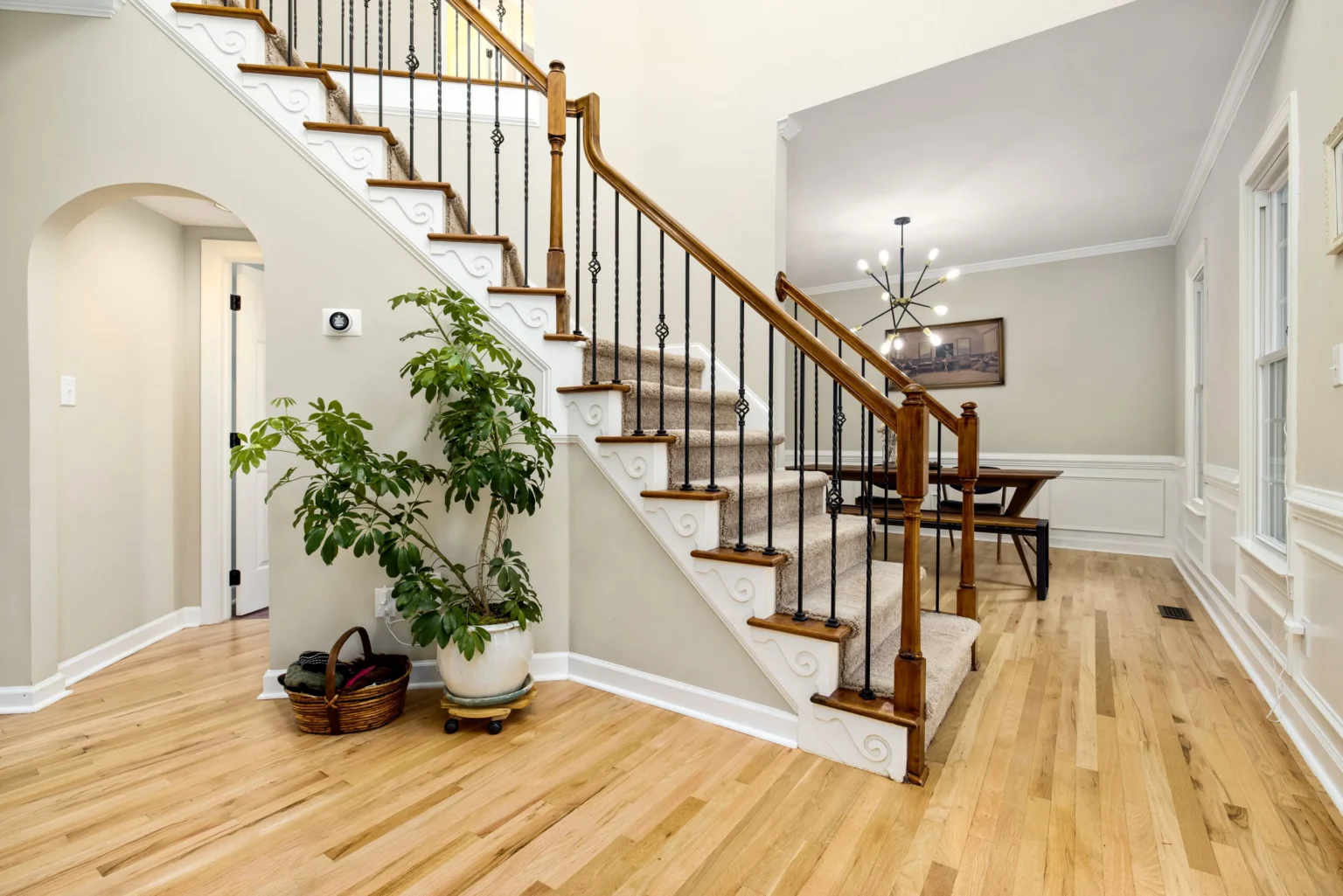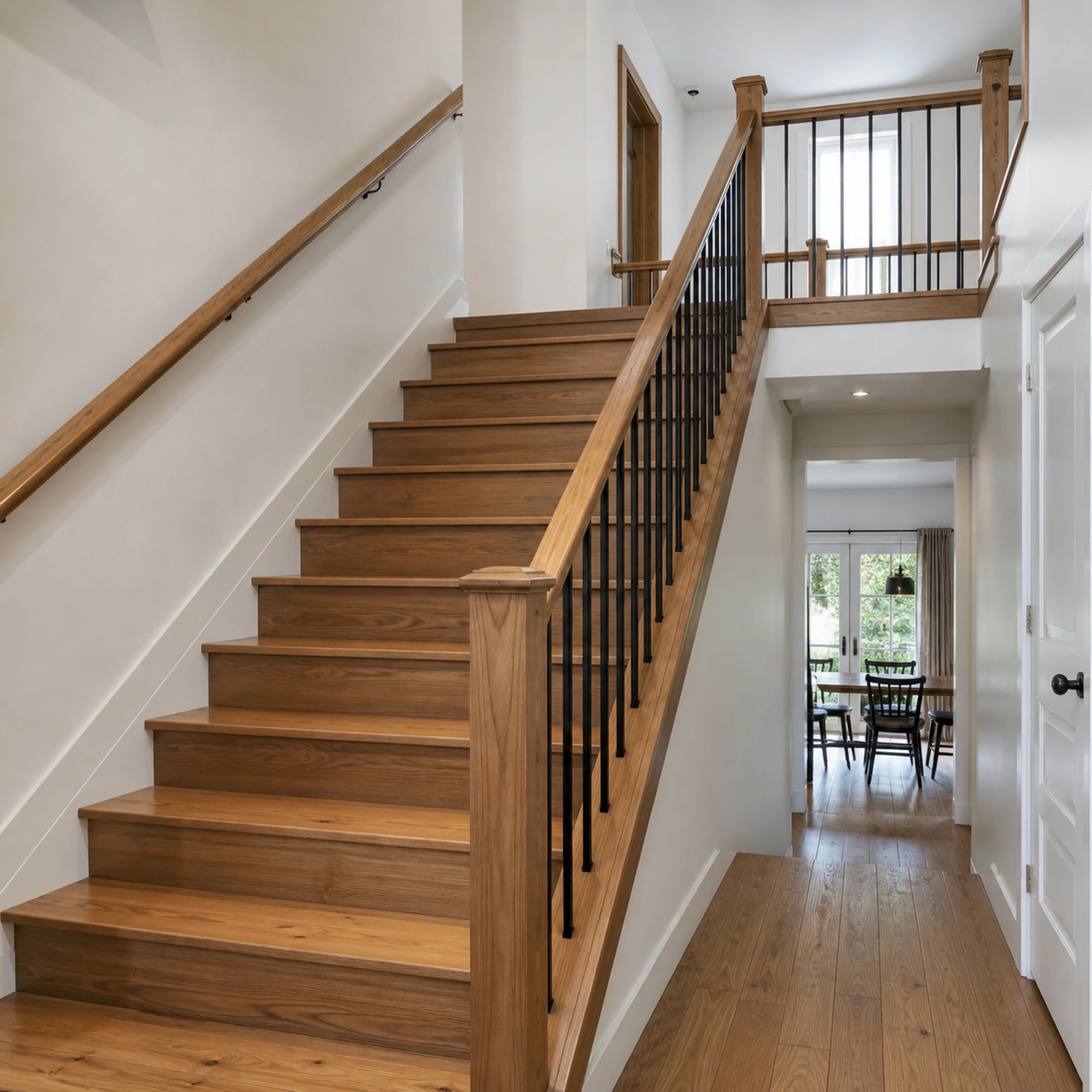
In Quebec, a private interior staircase must meet specific dimensions set out in section 9.8 of the Quebec Building Code: 255 mm to 355 mm (10 in. to 14 in.) tread depth, riser 125 mm to 200 mm (5 in. to 7⅞ in.), minimum width of 860 mm (34 in.) and minimum headroom of 1,950 mm (6 ft 5 in.). handrail becomes mandatory from the third riser, at a height of 865 mm to 965 mm measured from the stair nosing. railing is required whenever a fall of more than 600 mm is possible, with a minimum height of 900 mm inside a dwelling and a spacing between balusters never exceeding 100 mm.
A single non-compliant element makes the entire staircase non-compliant. Here is each requirement in millimetres and inches.
Attention: the Code changes on October 17, 2026
This is the point that most guides omit, and it changes everything for a project under planning.
The Quebec Construction Code, Chapter I – Building, 2020 edition (the “QCC 2020”) has been in force since April 17, 2025. A transition period still allows the previous edition, QCC 2015, to apply to projects whose work begins before October 17, 2026. After that date, QCC 2020 becomes mandatory for all new projects.
The most important difference is the tread depth:
| Edition | Minimum Spin | Application |
|---|---|---|
| CCQ 2015 | 210 mm (8¼ in) | Projects started before October 17, 2026 |
| CCQ 2020 | 255 mm (10 in) | Mandatory for any new project after this date |
In concrete terms: a staircase designed with a 230 mm pitch was acceptable yesterday and will no longer be. If you are planning work for 2027, design now according to the CCQ 2020, which is what we do in the workshop.
The selected edition must be documented from the design stage and remain the same throughout the project.
The three levels of regulation
A requirement can come from three sources, and the strictest one always applies:
- The National Building Code of Canada (NBC), published by the National Research Council of Canada, provides the basis.
- The Quebec Construction Code It is administered by the Régie du bâtiment du Québec (RBQ), which is the provincial government’s building inspection agency.
- Municipal by-laws Local requirements may be added, as is the case in several cities in the Montérégie and Estrie.
Always check with your municipality before starting any work.
Dimensions of the treads
| Component | Minimum | Maximum |
|---|---|---|
| Height of riser | 125 mm (5 in) | 200 mm (7er in) |
| Giron — CCQ 2020 | 255 mm (10 in) | 355 mm (14 in) |
| Width of the staircase | 860 mm (34 in) | — |
| Escape (free height) | 1,950 mm (6 ft 5 in) | — |
| Height of a fly without landing | — | 3,700 mm (12 ft) |
| Length of a landing | 860 mm (34 in) | — |
Consistency is a requirement in itself. The treads steps in the same row must be identical, with a tolerance of only a few millimeters between each step. The reason is simple: when descending, the foot anticipates the height of the previous step, and a variation is enough to cause a fall, which is one of the most common causes of domestic accidents on stairs.
Note: the tread depth is measured horizontally, from the stair nosing to the nose of the next step, not the total depth of the step, but the useful portion where the foot rests. On a winder staircase or spiral, the measurement is taken at the line of stride.
Handrails and railing
This is where confusion is most common, because the handrail and the railing obey separate rules.
| Component | Exigence | Trigger |
|---|---|---|
| handrail | Mandatory | More than 2 risers |
| Height of handrail | 865 mm to 965 mm (34 to 38 in) | Measured from stair nosing, along the fly |
| Second handrail | Mandatory | Staircase 1100 mm wide and more |
| Diameter of grip | Approx. 30 to 50 mm | handrail circular |
| railing | Mandatory | Possible drop of more than 600 mm (24 in) |
| Height of railing indoor | Minimum 900 mm (36 in) | Along the fly, in a housing |
| Height to landing or mezzanine | Minimum 1070 mm (42 in) | landing, mezzanine, significant elevation difference |
| Spacing of the balusters | Maximum 100 mm (4 in) | Any opening of the railing |
Do not confuse the two heights. The 1070 mm applies to the railing of an landing or mezzanine, not the handrail of a flight.A handrail placed at 1070 mm along a flight would be too high to be comfortably grasped, and not compliant.
The 100 mm rule, known as the “ball”, is in place to prevent a young child’s head from passing between two balusters. No 100 mm diameter spheres must be allowed to pass through the railing — including between the stringer and the first baluster.
The handrail must also remain continuous over the entire length of the staircase and not change side when a landing passes by: a visually impaired person must be able to follow it without having to look for it.
Compliant does not mean comfortable: the Blondel rule
The Code sets minimums and maximums, but it does not guarantee comfort. Blondel’s formula takes care of this:
2 × riser height + tread depth = 600 to 630 mm
A staircase can be perfectly compliant and still be difficult to climb. A riser of 190 mm with a 255 mm tread depth gives 635 mm — out of the comfort range: the stride will be unbalanced. calculator of stairs checks this rule automatically, in addition to the requirements of the Code.
Do I need a permit?
External staircase: a permit is required in all municipalities in Quebec, without exception.
Internal staircase: It depends on the nature of the work.
- Identical replacement, same location and same dimensions → usually no permit.
- Change of location, configuration or dimensions → permit generally required.
- Opening an stairwell opening or modifying a bearing element → permit required, engineering drawings often required.
The permit must be displayed on the site, and the inspector can show up at any time, so make sure you have the right permit.
What a non-compliant staircase risks
Beyond a possible notice of infringement, an out-of-standard staircase may:
- block the sale of the house — the inspector in building will indicate this in the pre-purchase report;
- compromise insurance coverage in the event of an accident;
- lead to an obligation to take back imposed by the municipality;
- commit your responsibility if a third party falls at your home.
This is also the reason why all staircase installers must hold a licence from the Régie du bâtiment du Québec (the Quebec Building Authority). 5725-9632-01, and you can check it at the RBQ public register.
Frequently Asked Questions
What is the statutory height of a walk in Quebec?
The riser should be between 125 mm (5 in) and 200 mm (7er in), and remain the same throughout the flight.
What is the minimum tread depth of a staircase?
255 mm (10 in) under the 2020 CCQ, up to a maximum of 355 mm (14 in). The old 2015 CCQ allowed 210 mm, but it will no longer apply to new projects after October 17, 2026.
What is the minimum width of an interior staircase?
860 mm (34 in), measured between finished wall surfaces.
From how many treads is a railing mandatory?
As soon as a staircase has more than two risers, that is, from the third step.
What is the height of an interior staircase railing?
Minimum 900 mm (36 in) along the fly in a housing, and 1070 mm (42 in) at landing or mezzanine.
What is the maximum spacing between the balusters?
100 mm (4 in.) No spheres with a diameter of 100 mm (4 in.) should be able to pass through the railing.
Do I need a permit to redo an interior staircase?
Yes, as soon as you change the location, dimensions or structure of the product, we will replace it.
Our role in
At Escaliers Messier, every staircase is designed to meet these requirements from the moment it is measured. We adjust giron, riser and railing to your actual opening, and we design according to the CCQ 2020 so that your staircase remains compliant after October 2026.
For more information, see our page on the railing of staircase, use our calculator of stairs, browse Our Staircases or discover Our Workshop. A doubt about the compliance of your project? Contact us for more information to discuss it.
The values presented are references taken from the Quebec Construction Code, section 9.8, and do not replace the consultation of the Code in force or the advice of a professional for your specific project.